When I first saw the Mr. Anuncio* on my screen, I was a little confused. He wasn’t what I had expected at all. Although 82 years old, and dressed casually in a white sando and baggy shorts, he still had the tanned complexion and erect bearing of a military man. He sat there as if he had a ramrod taped to his back, his thinning white hair waving gently around his head, and his rheumy but alert eyes magnified behind thick spectacles. They were based in rural Samar, so I could see coarse grass and gnarled trees behind him as he waited patiently on a bamboo bench on their front porch. He looked neither frail nor uncomfortable.
I glanced down at my notes and wondered if I was talking to the right patient. According to the medical history sent by his daughter, he had hypertension, diabetes, gallbladder stones, a repaired inguinal hernia, and Parkinson’s disease. He was taking a ton of medications for everything, and had been advised gallbladder removal several months prior, which he had refused because of the ongoing coronavirus pandemic. A retired army colonel, he ate a balanced diet consisting mostly of vegetables, and exercised daily. He had never smoked in his life. He was up-to-date with all of his vaccinations, including the ones for COVID. He had no history of asthma, tuberculosis, or any other chronic pulmonary diseases.
However, the reason why he had been referred to me was because had allegedly suffered five bouts of pneumonia in the past four months. I looked with disbelief at the antibiotics that he had been prescribed by three different doctors:
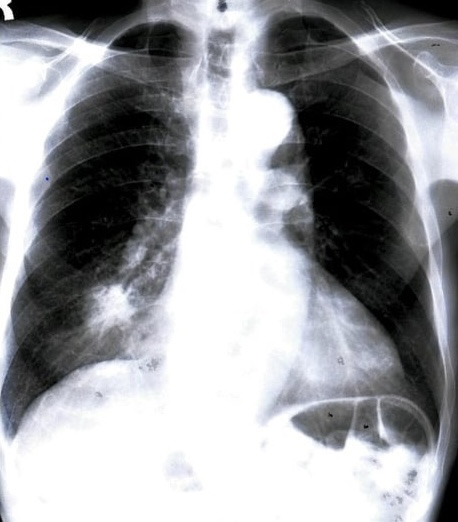
Azithromycin around four months ago, for an incidental chest x-ray finding of pneumonia on the right lower lung. This had cleared after treatment.
Levofloxacin three months ago, because of a slight cough with whitish phlegm and no other symptoms. Chest X-ray had not been done before or after treatment. The cough had apparently improved for a while, and then returned.
Ciprofloxacin 2 months ago, because the slight cough had worsened. A repeat X-ray had not been done. The cough had supposedly disappeared for few weeks.
Cefixime and Azithromycin a month ago, because the cough had recurred and worsened. Chest X-ray had been repeated prior to the antibiotics, showing recurrence of the pneumonia in the same area as the first one four months ago. The cough had improved after the antibiotics, so the X-ray had not been repeated.
A week ago, the patient had started coughing again, so he had undergone another chest X-ray, which again showed pneumonia on the right lower lung. COVID RT-PCR swab was negative. Levofloxacin had been prescribed, and then the patient had been finally referred to me.
No one else in the household was sick. No one smoked. The laboratories in the executive check-up he had undergone a few weeks ago had been unremarkable; not altogether normal, but acceptable for a person of his age.
With that history of recurrent pneumonia, I had been half-expecting a patient on long-term oxygen supplementation with visible signs of breathing difficulty. I gazed bemusedly at Mr. Anuncio, who somehow managed to convey amusement despite the vacant expression on his face. He must have known exactly what was going on through my mind. I glanced at the pulse oximeter blinking on his finger. His oxygen saturation was 98%, and his heart rate was 78. I didn’t need to count his respiratory rate to know that it was normal. His daughter obligingly aimed an infrared thermometer at his forehead and showed the reading to me. 36.5 degrees Celsius. If I didn’t know any better, I wouldn’t have thought that he was sick at all. Shaking my head, I proceeded to ask some questions.
Did he ever experience shortness of breath, chest pain, chest tightness, or wheezing in the past 4 months? Did his phlegm ever change in color? Did his oxygen saturation ever go down? No to everything.
Did he ever develop fever or flu-like symptoms such as colds, sore throat or joint pains? He had low-grade fever three months ago, but it had disappeared after a day and never returned.
Did he ever lose his appetite or have unexplained weight loss? No.
Did he ever have episodes of choking on food or liquids? For the first time, the patient nodded. Yes.
I leaned forward excitedly. Here, at last, was a possible cause. I asked them to describe the patient’s choking problem and how long it had been going on. Mr. Anuncio looked at his daughter and gestured, his hand shaking slightly. She cleared her throat. “It started several months ago. He chokes and coughs several times during meals, especially when he eats solid food. Because of that, we’ve been cutting his food up very finely, or mixing his rice with broth. But it still happens a few times a day.”
“And which came first, the swallowing issues, or the pneumonias?”
She thought for a moment. “The swallowing.”
In my mind, I did a triumphant fist-pump. Recurrent aspiration pneumonia, I thought, secondary to swallowing dysfunction which could be a complication of the Parkinson’s disease. Still, there was something slightly strange about the location of the infiltrates on his chest X-rays. Yes, they were in the right place for aspiration—but why did they keep returning to exactly the same spot each time?
I ruminated for a few seconds, then glanced at the clock. We had been talking for around fifteen minutes. In all that time, I had never heard Mr. Asuncio cough. “How long has he been taking the Levofloxacin this time around?”
The patient held up an outspread hand. Five days.
“And the cough is gone?”
The patient shrugged and looked at his daughter. She frowned. “He still coughs occasionally. But it was never that bad to begin with, even from the start. It waxes and wanes over time—I’m not even sure if the antibiotics have anything to do with it.”
I found myself frowning with her. This was a strange aspiration pneumonia, if that was what it was. The patient held up a finger and tried out his voice, which came out croaky. “Mas iniinda ko pa ang tiyan ko.” I’m more concerned about my stomach.
I turned questioningly to his daughter. She grinned unexpectedly. “That was how we found out about the first pneumonia,” she explained. “He wasn’t coughing or anything like that. But he was complaining of moderate to severe pain on the right upper part of his abdomen. We already knew about the gallstones from a recent abdominal ultrasound, but the doctor did additional tests to make sure, and that’s when we found the pneumonia on his X-ray. The doctor said that he was probably feeling referred pain from the lung.”
“Um, yes, that can happen,” I hedged. But to me, the story made the case even weirder. A pneumonia with severe referred pain that didn’t have respiratory manifestations at all in an elderly patient with multiple co-morbidities? I had never encountered anything like it before. Which, of course, made me think that it might not have been pneumonia at all. I looked down at my notes and slowly circled several things.
82 years old.
Chronic, intermittent cough.
Choking episodes.
Fluctuating infiltrates on the right lower lobe.
Right upper quadrant pain?
Diabetes.
Parkinson’s.
I nodded to myself and looked up at them both. “This could be aspiration pneumonia,” I began, “but his symptoms don’t really add up. We need to address the choking too, of course, but we also have to think of other diseases, like lower lobe tuberculosis, or cancer, or even something uncommon. In other words, I’m recommending more work-ups, not just simple X-rays. Is this ok with you?”
To my relief, the daughter nodded fervently. “Yes, doctor, anything to make Papa better.”
The patient hesitated, then gave me a thumbs-up.
Satisfied, I waved goodbye and proceeded to write down the laboratory tests that I had in mind. I requested for sputum AFB, sputum Gene Xpert, PPD, and a high-resolution chest CT scan. There were a few others that I could think of, but I wanted to see the results of of these ones first. In addition, I scribbled off referrals to Neurology and ENT for the Parkinson’s and the swallowing dysfunction. This might still be an atypical case of recurrent aspiration pneumonia, and if that was so, the most important thing to do was to prevent it from happening again.
After a week, the relative started emailing in the results as they arrived. The PPD, or skin test for tuberculosis, was negative, but the chest CT scan revealed tuberculosis on both upper lobes and on the right lower lobe of the lungs, with concomitant bronchiectasis (bronchiectasis is a condition wherein the airways become abnormally wide, leading to a build-up of mucus). I nodded smugly and congratulated myself for validating my main clinical impression. For a few days, I actually thought that the case was closed. However, the last email dealt a sharp slap to my ego.
The sputum Gene Xpert and AFB were both negative for tuberculosis. But there was a notation on the bottom of the result: PARAGONIMIASIS.
I stared at it blankly. Paragonimus westermani, or the lung fluke, is a parasite that can infest people who eat undercooked crustaceans such as crabs or crayfish. The larvae exit the intestines and burrow into the lungs, or sometimes even the brain or the muscles. Manifestations include diarrhea, nausea, abdominal pain, fever, cough, chest pain, rashes, enlargement of the liver and spleen, and pulmonary abnormalities on chest X-ray. In the Philippines, it is endemic to some regions such as Bicol, Leyte, Sorsogon, and Zamboanga. I didn’t know how common it was in Samar, where the patient resided. And frankly, this was only my second case. Ever. The first one had presented like this too—like pulmonary tuberculosis. In retrospect, some of the patient’s symptoms made sense now: the recurrent cough, the transient fever, the infiltrates that always appeared on the right lower lobe, even the abdominal pain. He had probably experienced the other symptoms too, except that they had happened so long ago that he’d forgotten.
When I had gotten over my surprise and consternation, I immediately referred the patient to my husband, who is an Infectious Diseases Specialist. I vaguely remembered the treatment for Paragonimiasis, and could have easily looked up the specifics myself, but since I barely had any experience on such cases, I didn’t want to make any mistakes.
As I detailed all of this to Mr. Anuncio’s daughter, I half-expected her to be appalled, or distraught, or even bewildered. However, her prevailing reaction to my explanation was relief. Relief, that we finally knew what was going on, and what to do about it. Her one question to me was, “Is it treatable?”
Happy that I could give a positive answer to this, I nodded rapidly. “Yes, yes, it’s treatable. My husband will tell you exactly how on your consultation with him.”
She clasped her hands and gave me a grateful smile. “Thanks so much, doctor.”
When I signed off, I found myself pulling my iPad closer so that I could research more about the subject. Maybe it was time that I learned more about it—just because I had only seen two cases in 18 years didn’t mean that there weren’t more out there, masquerading as tuberculosis or recurrent pneumonia or some other chronic respiratory illness that was being futilely bombarded with antibiotics without the benefit of further work-up. The takeaway lesson—at least for me—was, to quote Albert Einstein, “Insanity is doing the same thing over and over and expecting different results.” In other words, if a disease keeps recurring despite 5 courses of the same kind of medication, then the original diagnosis is probably wrong.
*Name and some details changed for the patient’s privacy.
 Waiting to Exhale: Lung Doc on Call
Leave a comment